Two research programmes — one focused on software, the other on the autoclave — converge in a machine that is new in substance, not merely in name.
A vacuum drying cycle takes several days and puts a valuable timber load at stake. The outcome only becomes apparent when the kiln is opened. The research presented here aims to change precisely that.
THE FIRST RESEARCH PROGRAMME: A MODEL TO PREDICT TIMBER BEHAVIOUR BEFORE THE BATCH IS LOADED
We are developing a mathematical model for hygro-thermo-mechanical simulation. It describes the coupled transport of moisture and heat within a board, the resulting deformation and the internal stresses that develop, providing the basis for cycle control.
The practical difference is substantial. A conventional drying cycle follows a predefined schedule, with safety margins established through experience. A model-based cycle can identify where stresses are developing, how close the material is to its failure threshold and how far the process can be intensified without risking cracking or collapse. In other words, it enables operation within the material’s actual safe physical limits, rather than relying on a precautionary margin set in advance.
The project is being carried out in collaboration with CSMT Innovation Hub in Brescia, which oversees technology transfer and the project’s scientific framework.
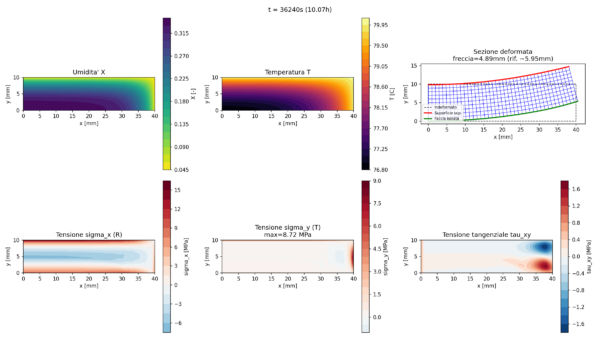
Quantities calculated by the model at a given point in the cycle: moisture content, temperature, deformed cross-section and the three internal stress components. Tangential stress is concentrated at the corner where the edge meets the exchange surface, consistent with observations reported in the literature.
VALIDATION PROCESS
For validation, the model was compared with a benchmark from the scientific literature. For the moisture field, it reproduces the reference with an error of 0.0355 in the contour comparison. On the mechanical side, a discrepancy remains in the calculated deformation. Five possible causes have already been investigated and ruled out individually. The cause remains unresolved, and this is explicitly documented in the technical report.
REFERENCE DATABASE
The database covers 46 timber species — 33 North American and 13 European — with 14 thermal, elastic and hygroscopic coefficients for each. Every value has a traceable source and an explicit code. Users can therefore always identify the reference timber species and the data they are actually using.
THE MODEL
Under load and changing moisture conditions, wood deforms considerably more than elasticity alone would predict. This is mechanosorptive creep, a phenomenon characteristic of wood. A purely elastic model overestimates internal stresses by a factor of 2.8 to 13, which would lead to unnecessarily slow and conservative drying schedules.
The module describing this behaviour, based on microprestress theory (Brown, Di Luzio and Cusatis, 2024), has remained stable in 40-hour simulations, even under ramps considerably more aggressive than those encountered in an actual drying cycle.
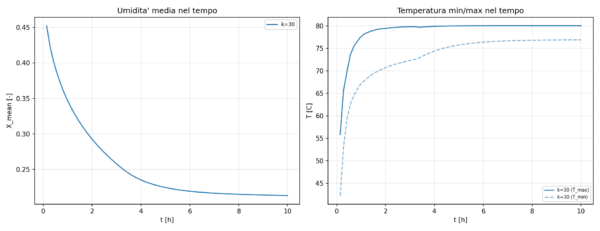
Moisture loss is concentrated in the first 4–6 hours, then slows as equilibrium is approached. The insulated face remains cooler for an extended period because of evaporative cooling.
WHY OUR EMX CYCLES ALTERNATE BETWEEN VACUUM AND ATMOSPHERIC PRESSURE
The model has confirmed, and explained, a principle that our systems have used for years. Under vacuum, moisture evaporates from the wood, cooling it in the process. Without an efficient means of replenishing heat, diffusion falls sharply and the benefit of the vacuum becomes self-limiting.
The atmospheric-pressure phase restores efficient heat transfer and reheats the board before diffusion drops too far. Alternating between the two phases keeps temperature, diffusion and capillary mobility close to their maximum useful levels for considerably longer than continuous vacuum operation.
The model provides a quantitative basis for deciding when to switch phases, according to the material and a dedicated simulation carried out in advance.
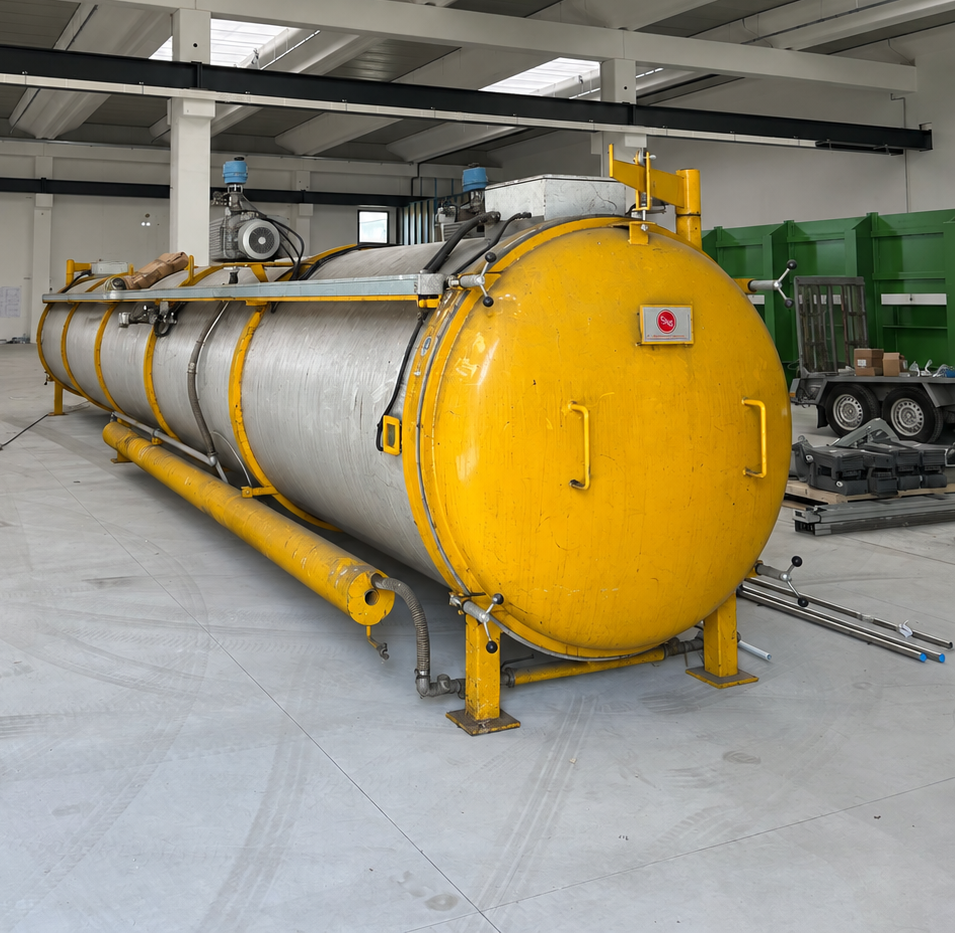
THE SECOND RESEARCH PROGRAMME: THE NEW EMX SERIES
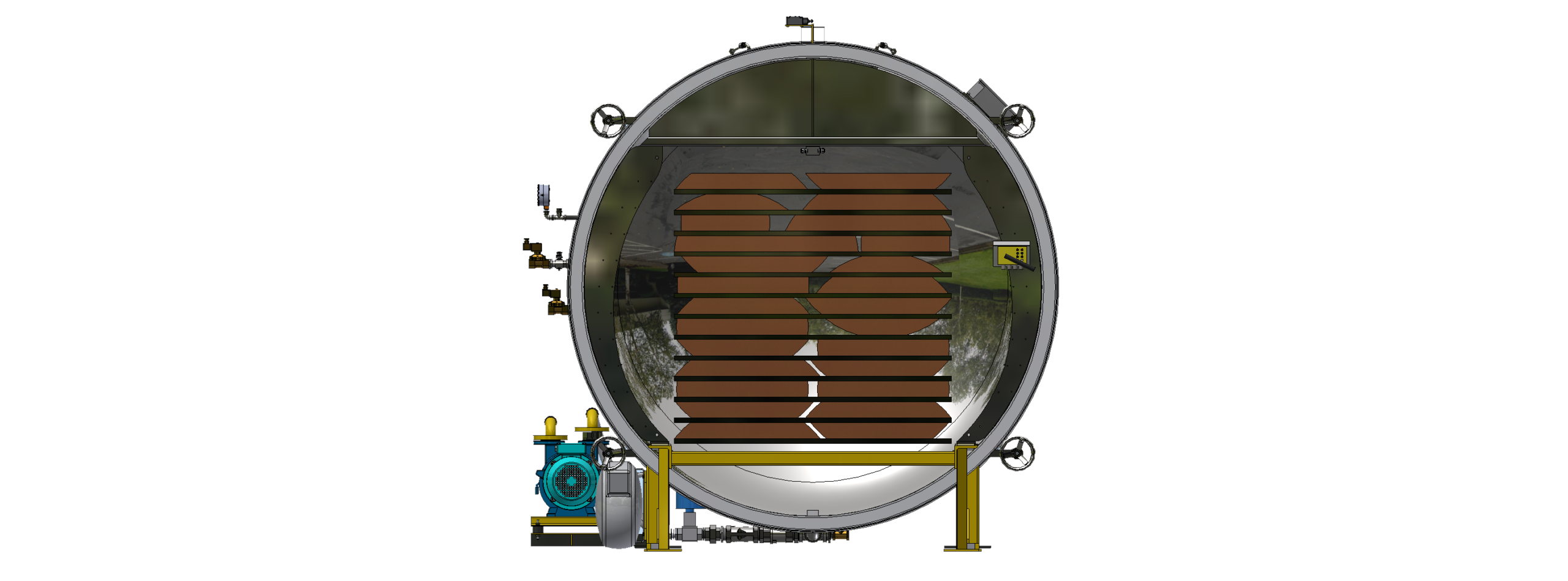
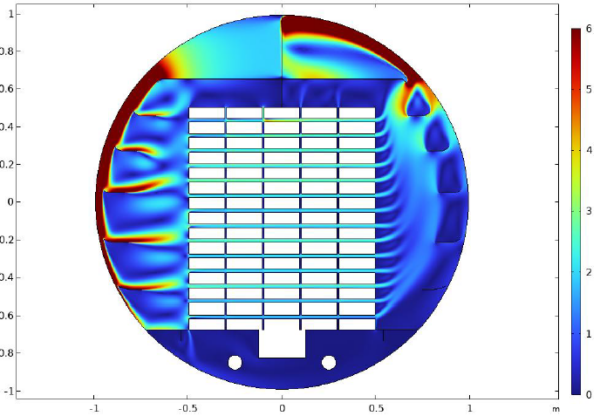
Even a sophisticated algorithm cannot compensate for a chamber with poor flow distribution. We therefore applied the same approach to the hardware. The EMX series originated from a fluid-dynamic analysis of the autoclave using numerical simulation tools, which led us to redesign its internal geometry rather than update an existing design.
THE RESULT
Hardware and software have been redesigned together, each supported by its own research, to operate as a single system. This reflects our approach to industrial innovation: starting with the physics of the process.
Where do we stand? The transport model has been validated, the mechanosorptive module is stable and the species database is complete. The remaining mechanical discrepancy and direct experimental validation are still open issues. The next steps are integration into the control loop and a programme of prototype testing.
We are at the testing stage, and we are transparent about that: we are making no premature promises.
If you process hardwoods and high-value timber, particularly thick sections of oak, beech, ash, maple, walnut or chestnut, and consistency of results matters more to you than hourly throughput, this is the direction in which we are investing.
We would welcome the opportunity to discuss your project. Please contact us at headoffice@isve.com.